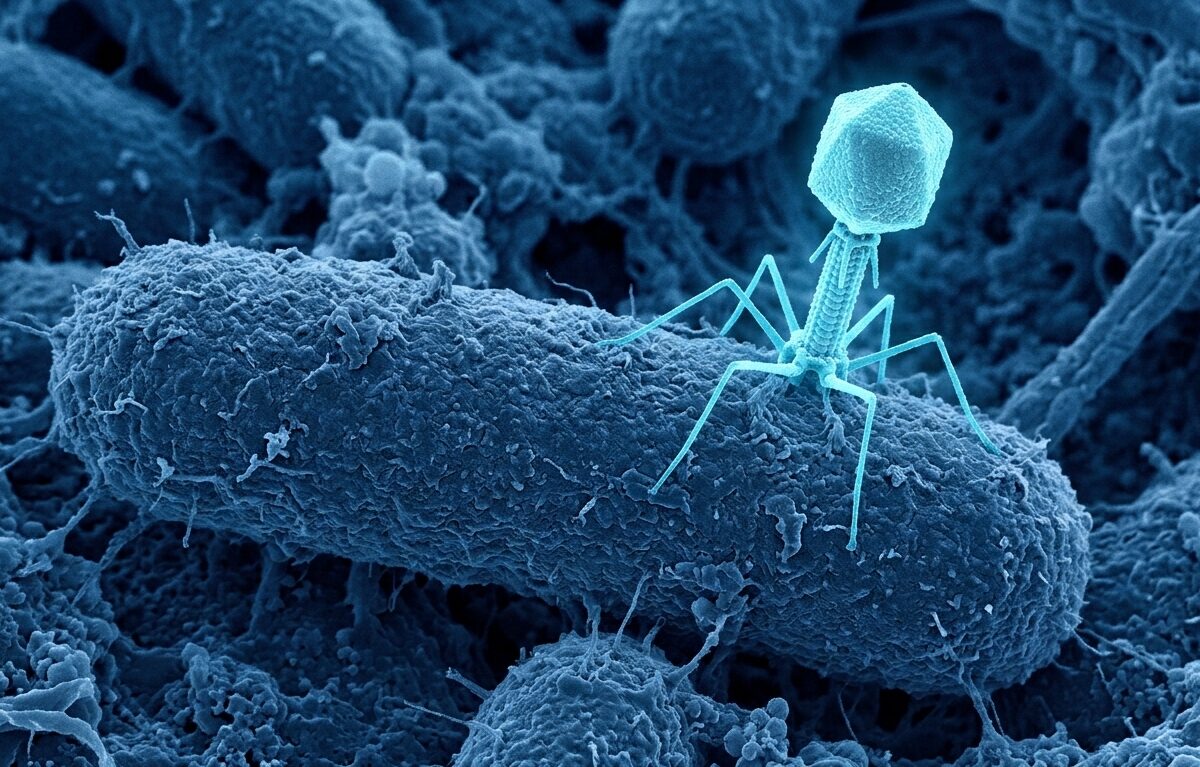
A research project led by Dr. Olaf Tyc of Universitätsmedizin Frankfurt aims to make personalized phage therapy faster and more precise for people with cystic fibrosis, Biermann Medizin reports. The work, carried out with researchers at the Netherlands Institute of Ecology (NIOO-KNAW), is funded by the Bundesverband Mukoviszidose with 19,985 euros. The project examines whether volatile organic compounds (VOCs) released by bacteria can serve as a biological fingerprint for matching phages to the strains infecting a patient's lungs.
Why it matters
Chronic lung infections with Pseudomonas aeruginosa are among the hardest problems in cystic fibrosis care, according to Biermann Medizin. The bacterium persists in the lungs, steadily worsens lung function, and can substantially reduce both quality of life and life expectancy for those affected. Standard antibiotics are also losing ground as resistance grows, which leaves clinicians with fewer reliable options.
Phage therapy — treatment with viruses that attack bacteria — is seen as a promising alternative. Its central difficulty is specificity: a given phage will only work against certain bacterial strains, so finding the right match for each patient is slow and uncertain. A faster way to identify which phage suits which infection could make the approach practical on a patient-by-patient basis.
Reading the bacterial fingerprint
The project's premise is that bacteria emit a characteristic mix of volatile organic compounds, and that this chemical signature can be used to tell strains apart. According to Biermann Medizin, the researchers intend to build metabolic profiles from these emissions and use them like a fingerprint. Such profiles could help identify which phages are likely to be effective, and could also support monitoring of how a treatment is progressing.
The team will draw on bacterial samples already held in biobanks, so no additional recruitment of people with cystic fibrosis is required. The bacteria will be studied under conditions that resemble the real lung environment, and the compounds they release will be captured with modern measurement techniques. Statistical analysis and machine learning methods will then be applied to turn the readings into dependable biomarkers for diagnosis and for tracking therapy.
If that works, the practical benefits are several. Suitable phages could be found sooner, treatment courses could be followed more closely, and antibiotics could be used more selectively — all of which the project frames as steps toward more individualized care and better quality of life for patients.
From the lab toward clinical use
The project is early-stage and laboratory-based, and its results are expected to be developed further in clinical trials over the coming years. Biermann Medizin reports that the findings could, in the longer term, become part of routine cystic fibrosis care.
What to watch: whether the VOC profiles prove reliable enough to distinguish bacterial strains consistently, and whether the machine-learning models built from biobank samples hold up when tested against real clinical isolates.